Medical colleges rise from 387 to over 800: Patel
Published: Sep 28, 2026
By TIOLCorplaws News Service
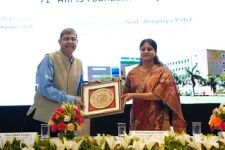
NEW DELHI, SEP 28, 2026: UNION Minister of State for Health & Family Welfare and Chemicals & Fertilizers, Anupriya Patel addressed the 71st Foundation Day celebrations of the All India Institute of Medical Sciences (AIIMS), New Delhi, as the Chief Guest friday. The celebrations marked over seven decades of AIIMS' contributions to healthcare, medical education, research and innovation.
Addressing the gathering, Anupriya Patel said that "since its inception in 1956, AIIMS New Delhi has occupied a special place in the healthcare journey of the country." She highlighted its contribution to redefining medical education, pioneering groundbreaking research and delivering high-quality patient care. She underlined that "over the decades, the name AIIMS has become synonymous with clinical excellence and public trust." She noted that while the institution has a distinguished legacy, this legacy also brings greater responsibility for the future and requires continued focus on national healthcare priorities.
Patel highlighted the transformation of India's healthcare and medical education landscape. She noted that the country has expanded from one AIIMS at the turn of the century to a network of 23 AIIMS institutions. Since 2014, the number of medical colleges has increased from 387 to over 800, while undergraduate medical seats have increased from 51,000 to nearly 1.3 lakh, along with a substantial expansion in postgraduate opportunities. "She further added that the Government envisions adding another 75,000 medical seats to further strengthen this framework. This expansion is not merely a matter of numbers but is closely linked to equity and access."
Patel further emphasized that "quality medical education must reach every region, advanced tertiary healthcare must be brought closer to citizens, and the country must build a strong pool of doctors, nurses, scientists and allied healthcare professionals capable of responding to changing demographic and epidemiological needs." She added that "AIIMS New Delhi has a special responsibility in this transformation as the apex mentor and as an institution that has established a benchmark for the rest of the country."
Speaking about the scale of healthcare services at AIIMS New Delhi, Patel said that the institution's enormous clinical volume should not be viewed merely through statistics. Millions of outpatient visits represent individuals and families placing their trust in the institution, while admissions and surgeries represent situations in which patients entrust their lives to its doctors, nurses and support staff. She emphasised that AIIMS is therefore not only a centre of medical excellence but also an institution of public trust, and that this trust has to be earned and nurtured every day.
Patel also highlighted AIIMS' role at the forefront of advanced medical care and emerging technologies, including Artificial Intelligence (AI), robotic surgery, organ transplantation and advanced diagnostics. She emphasised that "technology must remain an instrument for better patient care and should complement, rather than replace, human clinical judgement." She noted that "AI cannot replace a physician's intuition, a robotic arm cannot replace a surgeon's judgement, and technology cannot replace the reassuring human presence of a nurse." She stressed the importance of maintaining a balance between scientific advancement and the human touch in healthcare.