India International Water Week 2026 concludes with Focus on Climate-Resilient Management
Published: Sep 28, 2026
By TIOLCorplaws News Service
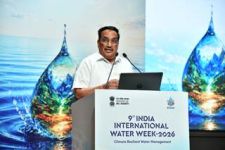
NEW DELHI, SEP 28, 2026: THE 9th India International Water Week (IIWW) 2026 concluded last Friday at Bharat Mandapam, New Delhi, with the Valedictory Ceremony chaired by Union Minister of Jal Shakti, C R Patil. Held from September 22–25 under the theme "Climate Resilient Water Management", the deliberations brought together policymakers, government officials, international organisations, development partners, researchers, academia, industry, water-sector practitioners, innovators and young professionals to discuss emerging challenges and solutions for water security.
The valedictory session was graced by Ministers of State for Jal Shakti; V. Somanna, Raj Bhushan Choudhary, Secretary, Department of Drinking Water and Sanitation, Ashok K. K. Meena, Secretary, Department of Water Resources, River Development and Ganga Rejuvenation, Archana Varma, Director General, National Mission for Clean Ganga, Rajeev Kumar Mital, AS & MD, NJJM, Department of Drinking Water and Sanitation, Kamal Kishore Soan, Chairman, Central Water Commission, Anupam Prasad, and Director General, National Water Development Agency, Baleshwar Thakur.
Addressing the gathering, C. R. Patil, Union Minister of Jal Shakti underscored that IIWW 2026 provided a platform for governments, experts, institutions, academia, industry and youth to deliberate on climate-resilient water management. He highlighted three key takeaways: people's participation in water conservation, taking science and technology to the ground, and strengthening international and institutional cooperation. Highlighting the Jal Jeevan Mission's impact since its launch in 2019, he said expanded access to household tap water has contributed to improved health, dignity and quality of life in rural communities, while reducing the time and effort spent by women in fetching water. Referring to a WHO assessment, he said that improved access to safe drinking water under the Mission has the potential to prevent a significant number of deaths among children and reduce the health burden associated with unsafe water. He stressed that the next phase of JJM must focus on ensuring adequate, regular, safe and sustainable drinking water services, with community participation, source sustainability and appropriate technology central to sustaining these gains.
Speaking at the Valedictory Ceremony, V. Somanna, Minister of State, Ministry of Jal Shakti, said that water security fundamentally means ensuring a better quality of life through safe and reliable drinking water, sanitation, clean surroundings and effective wastewater management. Highlighting the transformation brought about by the Jal Jeevan Mission under the leadership of Prime Minister Narendra Modi, he said the focus must now be on ensuring that drinking water services are safe, adequate, regular and sustainable. He underlined that drinking water, and sanitation must be addressed through an integrated approach, with safe management of greywater, wastewater and solid waste essential for protecting water sources and public health. He highlighted the progress under Swachh Bharat Mission-Grameen, including ODF Plus and solid and liquid waste management, as an important foundation for this approach. He said the learnings from deliberations during the India International Water Week would translate into practical action towards sustainable, people-centric water services and the vision of Viksit Bharat @2047.
Speaking at the event, Minister of State for Jal Shakti, Raj Bhushan Choudhary, highlighted India's efforts towards climate resilient water resources management through irrigation development, modernisation of command areas, dam rehabilitation, groundwater management and recharge, river rejuvenation, river interlinking, flood management, hydrological forecasting, reservoir management and improved water information systems. He stressed timely completion and effective utilisation of water resources projects and emphasised that investments must ultimately translate into measurable outcomes for people, agriculture, the economy and ecosystems.
astructure, water-quality management, emerging technologies, research, governance and practical solutions for strengthening rural water services.
The session on "Digital Public Infrastructure in the Water Sector" brought together senior government, international and technology experts to explore how interoperable data, AI, geospatial technologies and citizen-centric platforms can transform water governance and service delivery. Chaired by Kamal Kishore Soan, Additional Secretary & Mission Director, NJJM, and co-chaired by Mr. William Rex, World Bank, the session highlighted the vision of "Water as One Data", with Sujalam Bharat positioned as the digital public infrastructure for rural drinking water. Discussions covered trusted and authenticated datasets, geospatial asset mapping, citizen feedback, Jal Seva Analytics, the Rural Data Stack and the evolution of sectoral DPI from foundational platforms such as Aadhaar, DigiLocker and UPI to applications supporting leakage detection, predictive maintenance and asset management.
In his opening remarks, Kamal Kishore Soan highlighted that Digital Public Infrastructure is increasingly being recognised as an important foundation for delivering public services at scale. Drawing on India's experience with Aadhaar and UPI, he noted that common digital platforms can connect systems, support innovation and facilitate delivery of services to millions of citizens. He observed that the water sector presents a distinctive challenge as water services are closely linked with sources, infrastructure, institutions, geography and communities. With the Jal Jeevan Mission increasingly focusing on sustainable water services, improved governance and informed decision-making, the ability to connect and use data across these dimensions assumes greater significance.
Highlighting the broader vision of "Water as One Data", Soan stated that integrated data can strengthen planning, management and service delivery. Within this vision, Sujalam Bharat has been developed as the digital public infrastructure for rural drinking water. He emphasised that its significance lies not merely in digitising existing processes but in creating a common digital foundation on which future applications, analytical systems and decision-support capabilities can be developed. He stressed that the real value of DPI would not be determined by the volume of data generated, but by its ability to enable institutions to take better decisions and ultimately improve outcomes for citizens.
Speaking on the role of DPI in transforming the drinking water sector, Swati Meena Nayak highlighted the need to move beyond fragmented datasets and create an integrated, trusted and interoperable digital ecosystem. She noted that the drinking water sector already generates millions of data points through IoT devices, SCADA systems, field-level reporting and other digital platforms. The challenge is to ensure that these datasets are interoperable, authenticated, consistent and capable of supporting governance and policy decisions.
The session also explored how digital infrastructure can enable more responsive, proactive and citizen-centric water services. Sunita Jain highlighted Meri Panchayat for accessing water-service information and reporting issues through geo-tagged evidence, while Mr. Jean Martin shared Singapore's experience of advancing from SCADA and automation to GIS, smart metering, AI and digital twins. The session concluded with a demonstration of Google's Global Flood Hub, showcasing AI-enabled riverine and urban flash-flood forecasting. The discussions underscored that the value of DPI lies not merely in generating data, but in connecting trusted information across systems and translating it into better decisions, proactive management and improved services for citizens.
The second DDWS session, Water Quality and Cost-Effective Technology, brought together researchers and practitioners exploring innovations across water quality, ecological restoration, climate adaptation, groundwater assessment and water-sector instrumentation. Mr. Abhilash Tiwari presented a microalgae-based phytoremediation pilot that reported improvements in DO, BOD, COD, pH, biodiversity and odour, alongside carbon sequestration and lower operating costs. Mr. Suresh Sharma presented research on extensive green roofs, demonstrating increased rainfall retention and reduced peak runoff across different soil, biochar and manure configurations. The session also highlighted microplastics as an emerging water-quality concern, with Mr. Srinivas Bilakanti calling for stronger sampling, analytical and monitoring protocols.