Indo-Africa Roundtable on WASH held as part of India International WASH Conference
Published: Sep 25, 2026
By TIOLCorplaws News Service
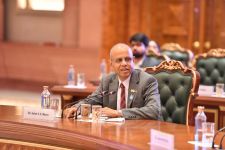
NEW DELHI, SEP 25, 2026: AS part of the Second India International WASH Conference being organised during the 9th India International Water Week (IIWW) 2026, the Department of Drinking Water and Sanitation (DDWS), Ministry of Jal Shakti, Government of India, yesterday convened a high-level Indo-Africa Roundtable on Water, Sanitation and Hygiene (WASH) at Bharat Mandapam, New Delhi to deliberate on shared water and sanitation challenges and explore opportunities for future cooperation.
The roundtable brought together Ambassadors and representatives of 22 African countries, senior officials of the Government of India, development partners, international organisations. AICTE-affiliated engineering students from the National Capital Region are called to witness the deliberations.
Setting the Context Ashok K. K. Meena, Secretary, DDWS, highlighted that India's experience in rural water supply and sanitation extends beyond physical infrastructure and is fundamentally about public health, dignity, women's empowerment and community ownership. He emphasised that strong political commitment and local institutional ownership have been central to India's progress under the Jal Jeevan Mission (JJM) and Swachh Bharat Mission-Gramin (SBM-G). Drawing attention to the decentralised governance framework adopted in India, he underlined the critical role played by Gram Panchayats and Village Water and Sanitation Committees in planning, operation, monitoring and sustainability of rural services.
Meena further highlighted that over 2.48 million women have been trained in the use of Field Testing Kits for water-quality surveillance, making women active participants in local water governance. He also recalled the transformative impact of Swachh Bharat Mission-Gramin, which converted sanitation into a nationwide people's movement through behavioural change, local leadership and community participation. Emphasising the importance of sustainability, he outlined five key lessons from India's experience: strong political leadership, empowered local governments, investment in people alongside infrastructure, planning for operation and maintenance from the outset, and the use of simple and interoperable digital systems for accountability and service delivery.
Secretary DDWS, said that India is honored to share its operational knowledge, digital approaches and experience in community governance, while learning from innovations and experiences emerging across Africa. The objective of this deliberation is to learn from one another and strengthen approaches that can deliver safe water, dignified sanitation and resilient services for communities. Such cooperation can contribute meaningfully to the achievement of Sustainable Development Goal 6.
Presenting India's experience in rural drinking-water service delivery, Kamal Kishore Soan, Additional Secretary and Mission Director, National Jal Jeevan Mission, highlighted the unprecedented scale of investments made that shows political will. Launch of Jal Jeevan Mission on 15 August 2019 marked a decisive shift towards ensuring functional tap-water connections for every rural household. The experience has reinforced the importance of political commitment, public investment, coordinated implementation and community participation. He noted that these lessons can contribute to the wider exchange of knowledge among countries seeking to strengthen reliable and sustainable rural water services. He presented that tap-water coverage has increased from 32.4 million rural households in 2019 to over 159.4 million households yesterday and explained how the Mission has addressed long-standing challenges of limited piped-water supply, non-functional schemes, excessive dependence on groundwater and water-quality concerns through a combination of infrastructure development, source sustainability measures, water-quality monitoring and community participation.
He informed that India's rural water-management strategy is increasingly focused on sustainability, including a gradual shift from groundwater dependence towards greater utilisation of surface-water sources. He also showcased Sujalam Bharat, India's emerging Digital Public Infrastructure for rural water governance, which aims to provide source-to-tap visibility, digital asset mapping, data-driven governance and improved service management through a common interoperable digital backbone.
Presenting India's sanitation journey, Aishvarya Singh, Joint Secretary and Mission Director, Swachh Bharat Mission-Gramin, highlighted how the the Mission transformed sanitation into a peoples' movement through unprecedented community participation and behavioural change. She noted that more than 120 million household toilets have been constructed since 2014, helping India achieve universal sanitation coverage and attain SDG target 6.2 ahead of schedule.
She stated that SBM-G has now moved beyond toilet construction towards sustainable rural sanitation service delivery. The current focus includes solid and liquid waste management, visual cleanliness, ODF Plus Model Villages, digital monitoring systems and institutional mechanisms for regular assessment of sanitation services. She also highlighted recent initiatives such as Swachh Seva Aandolan and efforts to institutionalise sanitation service delivery through local governments, digital systems and community-led verification. Stressing the importance of behaviour change, she observed that sanitation outcomes can be sustained only when communities themselves become custodians of cleanliness and public-health gains.
Delivering the global perspective, Mr. Saroj Kumar Jha, Global Director-Water, World Bank, described India's water and sanitation transformation as one of the most significant examples of large-scale development change witnessed across developing countries. He observed that strong political leadership, institutional coordination, innovative financing, public investment and community participation were key factors behind the success.
Highlighting the global water-security challenge, he noted that billions of people worldwide continue to lack access to safe water and sanitation services. He emphasised that water security is fundamental to economic growth, employment generation, prosperity and social stability. He called for greater global investments in water and sanitation, stronger political commitment and enhanced partnerships, while also emphasising that Africa should be viewed not only through the lens of challenges but also as a source of innovation, enterprise and locally developed solutions. He welcomed the India-Africa dialogue and advocated for continued engagement and institutionalised cooperation between the two regions.
Representatives from the World Bank, World Health Organization (WHO), UNICEF, Sanitation and Water for All (SWA) and BISAG-N shared international experiences, innovations and best practices in WASH service delivery. Discussions highlighted the increasing role of digital technologies, geospatial tools, community institutions, water-quality surveillance, climate resilience and evidence-based policymaking in strengthening water and sanitation systems. Participants also emphasised the importance of partnerships among governments, communities, development organisations and technology institutions for achieving sustainable WASH outcomes.
Mr. Yvan J.-F. Hutin, representing the World Health Organization (WHO), underscored the close links between safe drinking water, sanitation and public health outcomes, and highlighted the importance of water-quality surveillance, preventive health measures and resilient WASH systems. Mr. Paulos Workneh, Chief WASH, India, UNICEF, shared experiences on community-centred service delivery, behaviour change, inclusion and strengthening WASH services for women, children and vulnerable populations. Ruchika Shiva, Director, Global & Asia Regional Programme, Sanitation and Water for All (SWA), emphasised the importance of multi-stakeholder partnerships, country-led action, accountability and collaborative approaches for achieving universal access to water and sanitation. Dr. Vinay Thakur, Director General, BISAG-N, showcased the use of geospatial technologies, GIS-based planning and digital mapping solutions for monitoring water infrastructure, improving asset management and enabling data-driven decision-making in the WASH sector. Collectively, the speakers highlighted the growing role of digital innovation, climate resilience, community participation and evidence-based governance in strengthening sustainable WASH systems.
Addressing the gathering, Shivala Naik Mude, Additional Secretary, Ministry of External Affairs, highlighted India's longstanding development partnership with African countries and reaffirmed the country's commitment to supporting Africa through infrastructure development, institutional capacity building and knowledge exchange. He noted that Digital Public Infrastructure, water-resource management and technical cooperation present significant opportunities for future India-Africa collaboration. Recalling the historical and civilisational ties between India and Africa, he emphasised the importance of working together as partners of the Global South to address common development challenges.
During the interactive session, Ambassadors and representatives of African countries shared experiences and perspectives on water security, sanitation, irrigation, climate resilience and sustainable infrastructure development in their countries. They acknowledged India's achievements in expanding access to drinking water and sanitation and highlighted several common priorities, including water harvesting, groundwater management, wastewater treatment and reuse, source sustainability, affordable water-treatment technologies, waste management, digital water governance and climate-resilient infrastructure.
The discussions underscored the need for practical, affordable and locally adaptable solutions, particularly for rural, drought-prone and underserved communities. African representatives also highlighted the importance of sustainable financing, effective operation and maintenance systems, institutional capacity building, private sector participation and development of local technical skills. Several participants expressed interest in pursuing government-to-government cooperation, technical exchanges, pilot projects, research partnerships, academic collaboration and exposure visits to facilitate knowledge sharing and technology transfer.
The day started with welcoming the participants by D. Senthil Pandian, Joint Secretary, DDWS. He called the roundtable as an important platform for strengthening cooperation among countries facing similar development challenges. Highlighting the global water challenge, he observed that access to safe drinking water is not merely an infrastructure issue but one of dignity, health and opportunity. Referring to India's experience under the Jal.
In her concluding remarks, Smt. Swati Meena Naik, Joint Secretary, DDWS, said that the deliberations reaffirmed a common understanding that safe drinking water, sanitation and hygiene are fundamental to public health, dignity, gender equality and sustainable development.
Focusing on the way forward, she stated that the deliberations had opened new avenues for India-Africa cooperation in water security and sanitation . She highlighted knowledge exchange, capacity building, water-quality management, digital public infrastructure for WASH, community-led governance, climate-resilient water systems and sustainable sanitation as priority areas for future engagement. She further noted that SPM-NIWAS could support this cooperation through training programmes, exposure visits and technical exchanges. Emphasising a partnership-based approach, she stated that the objective would be to jointly develop affordable, scalable and locally adaptable solutions for achieving sustainable WASH outcomes.
Jeevan Mission and Swachh Bharat Mission, he emphasised that long-term sustainability of water and sanitation services can only be achieved when communities themselves become active stakeholders and owners of the assets created. He underlined the importance of collective action and knowledge sharing at a time when the global community is working towards achieving Sustainable Development Goal 6 on Clean Water and Sanitation for All by 2030.
The roundtable concludes with a deepen India-Africa cooperation through sustained engagement, mutual learning and practical partnerships. The deliberations reaffirmed the importance of South-South cooperation in accelerating progress towards safe water, dignified sanitation and climate-resilient WASH services for all.