DDWS organises 7th District Collectors' Peyjal Samvad
Published: Apr 16, 2026
By TIOLCorplaws News Service
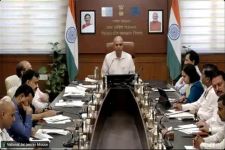
NEW DELHI, APR 16, 2026: THE Department of Drinking Water & Sanitation (DDWS), Ministry of Jal Shakti, organised the 7th edition of the District Collectors' Peyjal Samvad today through video conferencing, bringing together senior officials, District Collectors, Deputy Commissioners, and Mission Directors to deliberate on accelerating the implementation of Jal Jeevan Mission (JJM) 2.0 and Swachh Bharat Mission-Grameen (SBM-G) Phase 2 and sharing of best practices.
The Samvad was chaired by Ashok K.K. Meena, Secretary, DDWS, in the presence of Kamal Kishore Soan, Additional Secretary & Mission Director, National Jal Jeevan Mission (NJJM), Aishwarya Singh, Joint Secretary & Mission Director (SBM-G), along with Senior officers from DDWS.
In his address, Secretary DDWS, Ashok K.K. Meena highlighted the vision of Prime Minister Narendra Modi to provide safe tap water to every rural household under Jal Jeevan Mission and ensure cleanliness in villages under Swachh Bharat Mission Grameen. While setting the context for the meeting, he described the District Collectors' Peyjal Samvad as a vibrant and effective platform for sharing innovative ideas.
Ashok K.K Meena further stated that funding under Jal Jeevan Mission is now closely linked to the functionality and performance of water supply schemes. He highlighted the introduction of "Jal Arpan" which is the systematic handing over of completed water supply assets to Gram Panchayats after a mandatory 15-day trial run to ensure quality and reliability. He also mentioned about "Jal Seva Aankalan", an innovative mechanism that enables consumers and Gram Panchayats to self-assess the quality and service levels of drinking water supply. While highlighting the importance of creating digital footprints of water assets through "Sujala Gaon ID" and "Sujalam Bharat App" at the Gram Panchayat level, he urged the district collectors in ensuring effective monitoring and implementation of these initiatives and creation of the IDs at GP level. He further stressed the need to accelerate Har Ghar Jal certification, strictly implementing Operation & Maintenance (O&M) policies, and ensuring long-term sustainability of rural water supply systems.
DDWS Presentation on Jal Seva Aankalan & District Improvement Plan
A comprehensive presentation on Jal Seva Aankalan & District Improvement Plan was delivered by Ankita Chakravarty, Deputy Secretary, NJJM. E-launched on 30th December 2025 by the Union Minister of Jal Shakti C.R. Patil, Jal Seva Aankalan establishes a nationwide Gram Panchayat-led functionality assessment mechanism for rural drinking water systems.
Ankita Chakravarty detailed the structured Framework, Gram Panchayat Assessment Form (village-level data entry by Panchayat Secretaries on JJM-IMIS using e-Gram Swaraj login post-Gram Sabha), District Technical Unit (DTU) Review Form (technical diagnosis of adverse feedback, deadline 20th April 2026), District Improvement Plan (DIP) featuring auto-aggregated data with pre-defined solution baskets and timeline-based actions requiring 90% GP forms, DTU completion, and DWSM meetings, and State Service Improvement Plan (SIP) aggregating district-level plans.
Emphasizing the way forward, she urged District Collectors to expedite DTU assessments, convene DWSM meetings as DIP prerequisites, and commence DIP entry within four weeks, with progress tracking via Format B48 on JJM-IMIS. Jal Seva Aankalan transforms Panchayats from infrastructure recipients to active water service governors, generating actionable insights for sustainable rural water delivery through community-driven accountability and evidence-based corrective planning.
Innovative Best Practices Shared by Districts Through Presentations
During the Peyjal Samvad, a total of five districts presented their progress and best field practices which will further help other State's districts to develop better under JJM 2.0 and SBM-G Phase 2. Each presentation was delivered by the respective District Collector/ District Magistrate/ Deputy Commissioner/ District Officials.
Tehri Garhwal, Uttarakhand: Nitika Khandelwal, District Magistrate showcased the district's impressive progress with 99.72% Functional Household Tap Connection (FHTC) coverage and 81.32% Har Ghar Jal coverage. She also mentioned that under the scheme's development programmes Quality Assurance, Regular monitoring, continuous DWSM meetings, Handover of O&M is taken care. While highlighting this, villages Indwal Gaon and Village Kot came as the best villages for user collection charges. Further, she emphasized on Institutional Convergence for Source Sustainability, under which a key initiative is the convergence with the Spring and River Rejuvenation Authority (SARRA), which works in coordination with departments such as Irrigation, Forest, and Rural Development. Scientific DPRs and gap funding support ensure sustainable water sources, especially in hilly and forest areas. She further highlighted other best practices such as digitization through creation of KML files for created assets under JJM which is uploaded in PM Gati Shakti Portal, Grievance Redressal and NABL Accreditation of District Lab.
Under the SBM-G Phase 2, Nitika highlighted GP Katkhet, Tehri's Greywater Management Saturation Approach. She mentioned that the villages have achieved 100% grey water management coverage, and this model promotes sustainable water use and environmental protection.
Secretary DDWS appreciated the convergence model SARRA for Source Sustainability and urged that states and districts to come up with such innovative models.
Koderma, Jharkhand: Rituraj, Deputy Commissioner highlighted that the district has demonstrated a robust implementation model under JJM through a convergence-driven, technology-enabled, and community-centric approach. The district spans 1,655 sq. km with nearly 40% forest cover and is situated in the lower plateau region faces certain challenges across planning, implementation, and O&M stages included land and source identification and inter-departmental coordination. However, with the best key strategies like real-time data-driven monitoring through JJM dashboards and geo-tagged verification, Community Engagement, Scaling of successful SVS, Grievance redressal through State Government App JHARJAL and District monitored app MEETA, an evidence-based decision-making is carried forward for implementation of JJM. He further highlighted that technology-driven governance has been strengthened through the JHARJAL App for real-time grievance redressal within 72 hours, along with digital tracking of user charges and complaints. The district has also prioritized source sustainability through scientific planning, water budgeting, recharge structures, and revival of traditional water bodies, while ensuring over 95% water quality testing coverage through field test kits and laboratory systems.
Under Swachh Bharat Mission (Grameen), he shared that the district has achieved significant success in greywater management with 97% coverage and top state rankings across sanitation indicators. Overall, the district's integrated approach has led to improved service delivery, enhanced community ownership, and sustainable water management outcomes.
Anantnag, Jammu Kashmir: Dr. Bilal Mohiuddin Bhat, Deputy Commissioner demonstrated a transformative and convergence-driven implementation model under JJM, marked by strong institutional coordination, community participation, and focus on sustainability. Landmark case studies of Nilphan and Masawati-Top highlight the impact, where habitations facing decades-long water scarcity, forcing women to walk 10 km or rely on snow-melt have now been provided with assured tap water supply, significantly improving quality of life. The key best practice is the single-window, district-led convergence mechanism, with over 8 departments coordinated under the District Water & Sanitation Mission (DWSM), ensuring zero-delay clearances, seamless land allocation, and synchronized execution.
Further, under SBM-G the district has achieved 100% greywater management coverage through a saturation approach involving community and household soak pits, reinforcing environmental sustainability.
Raebareli, Uttar Pradesh: Harshita Mathur, District Collector presented the district's progress under the Jal Jeevan Mission and Swachh Bharat Mission-Grameen (Phase 2). She informed that out of the total targeted households the district has achieved 93.46% coverage and is continuously working to reach a 100% coverage. She mentioned that for grievance redressal and citizen engagement, the district is actively using the ‘JAL SARTHI' app, a user-friendly mobile application, available on both Android and iOS platforms, enables people to promptly report water supply-related issues.
Under Swachh Bharat Mission-Grameen (Phase 2), the district has achieved significant success in solid and liquid waste management. The district has operationalised 10 Faecal Sludge Treatment Plants (FSTPs) and is actively implementing Material Recovery Facilities for scientific waste management.
Vijayapura, Karnataka: Dr. Anand K, Deputy Commissioner highlighted that the district has implemented 40 Multi-Village Schemes (MVS) using sustainable surface water sources from Almatti and Narayanpur Dams on the Krishna and Bhima rivers. He mentioned that the notable achievements include two large Design-Build-Operate-Transfer (DBOT) mode MVS projects. Dr. Anand informed that the district has achieved substantial progress in providing Functional Household Tap Connections (FHTC). The focus has now shifted from water availability to efficient distribution and sustainability. He further mentioned that the district has adopted Operation & Maintenance (O&M) Policy in all Gram Panchayats, with separate accounting for water-related expenses and prompt repair works. He also highlighted Channamma, SHG representative being awarded during National Jal Mahotsav for her continuous support under HGJ.
Under SBM-G Phase 2, Vijayapura has declared 270 villages (41.52%) as ODF Plus Model villages. He further highlighted the district is following a community-level saturation approach for both solid waste management and community sanitary complexes through convergence of SBM-G and MGNREGA funds.
These presentations showcased achievements, ongoing challenges, and best practices under JJM and SBM-G, underlining the diversity of approaches adopted to accelerate progress under Har Ghar Jal and Swachh Bharat Mission Grameen.
While addressing the meeting Aishwarya Singh, Joint Secretary & Mission Director (SBM-G), highlighted upon the states close achievement towards attaining of 100% ODF free village under SBM-G Phase 2. She urged all District Collectors to collaborate closely with their respective district officers and work diligently to achieve full coverage under Solid Waste Management and Liquid Waste Management components of the mission, thereby fulfilling the objectives of SBM-G Phase 2 in a time-bound manner.
In his concluding address, Kamal Kishore Soan, Additional Secretary & Mission Director, NJJM, praised the innovative approaches shared by districts and underscored that the success of JJM 2.0 and SBM-G Phase 2 ultimately depends on the proactive leadership of District Collectors. He urged the administrators to conduct regular monthly DWSM meetings with advance review of dashboard data and emphasised priority areas including Jal Seva Aankalan, Jal Arpan, strengthening of District Technical Units (DTUs) and a focus on Greywater management.
The 7th edition of District Collectors' Peyjal Samvad was attended by participants across the country including District Collector/ Deputy Commissioner/ District Officials, Mission Directors, and State Mission Teams, from State/UTs.