Youth Unrest & CJP Agitation: Key Learnings
Published: Jul 27, 2026

By Pratap Singh
THE growing stress and unrest among Indian youth is a complex issue driven by structural, social, and psychological factors. The birth of Cockroach Janata Party and its agitation for over 37 days at Jantar Mantar Delhi is an example of that. Initially the Government didn't take it seriously, in anticipation that it will fizzle out on its own. What began on May 16, 2026, as an online satirical parody by political strategist Abhijeet Dipke-in response to a controversial judicial remark comparing unemployed youth and activists to "cockroaches"-rapidly evolved into a massive, nationwide agitation. With Parliament session on and opposition supporting the movement put the government under pressure. Centered on systemic issues like the NEET-UG 2026 paper leak, youth unemployment, and institutional accountability, the 37-day movement culminated in July 2026 with widespread public discourse and the resignation of Union Education Minister Dharmendra Pradhan. Infact the lack of opportunity is driving the youth crazy. Understanding these root causes provides clarity on how individuals, families, and institutions can effectively channel this energy toward growth.
The rise and impact of the CJP offer critical learnings about youth dynamics, digital politics, and state-citizen interactions in the modern era.
Key Learnings from the Movement
Reclaiming Elitist Slurs as Symbols of Resilience
When high-ranking institutions or authorities dismiss youth frustration using derogatory terms ("cockroaches," "parasites," "lazy"), it can backfire spectacularly. The movement embraced the insult, turning it into a badge of identity. Cockroaches are biologically associated with extreme survival and resistance to eradication. By adopting the name, youth signaled that no matter how dismissive or oppressive the system is, they will persist.
Satire & Memes as Potent Political Tools
Gen Z is often disengaged from traditional, formal political rhetoric. Satire, self-deprecating humor, and meme culture provided an accessible, relatable vocabulary for expressing deep structural anger without feeling bogged down by partisan ideology. By leveraging digital platforms, AI-assisted branding, and social media satire, CJP gained millions of followers within days, outpacing the digital reach of established political parties.
"Digital Anger" Can Translate to Real-World Impact
Skeptics often dismiss digital activism as "slacktivism." CJP proved that when online outrage aligns with concrete, lived anxieties-such as repeated exam paper leaks, suicides among aspirants, and unemployment-it can easily transition into sustained physical sit-ins, hunger strikes, and street demonstrations. The agitation demonstrated that a decentralized, non-traditional movement can force concrete policy action and executive accountability, such as ministerial resignations and fast-tracked judicial/examination reforms.
Underestimating Youth Anxiety:
The agitation highlighted a dangerous gulf between decision-makers and young citizens struggling with hyper-competitive exams and job scarcity. Dismissive or paternalistic responses from leaders (or silent celebrities) only deepened public resentment. The movement's core manifesto-focused on anti-corruption, electoral transparency, anti-paper-leak enforcement, and systemic reform-underscored that youth care deeply about clean governance and meritocracy.
Why Is There Unrest and Stress in Indian Youth?
Hyper-Competitive Ecosystem for Top Tier Colleges: The intense competition for top-tier higher education institutions like IITs, NEET, IIMs puts immense pressure on young individuals. Entrance exams and board examinations are often framed as make-or-break moments, fostering a constant fear of failure. For example ratio of successful candidates to participants is 1:50 for NEET and even higher for IITs. For IIMs it is even much more. This results into many students who wants to become doctors or management graduates go abroad. Why is it so that we are not able to create sufficient number of colleges, even including in private sector, so that if someone wishes to become a doctor, he/she may get a medical seat. As the seats are so scarce, a small section of students or their parents and in many cases some coaching centres try unfair means resulting into leakage of NEET paper, which has resulted in to birth of Cockroach Janata Party and its 37 days agitation at Jantar Mantar resulting in to Education Minister Dharmendra Pradhan's resignation. Let's look at Neet competition metrics:
NEET Competition Breakdown
- Total Registrations: ~22.79 lakh students registered.
- Total Appeared: ~19.99 to 22.05 lakh students appeared.
- Total Qualified: ~11.21 lakh students cleared the minimum cut-off percentile.
- Total MBBS Seats: ~1.36 lakh seats (covering both government and private colleges).
Ratios and Difficulty Metrics : Under NEET roughly 16 to 17 candidates compete for every single MBBS seat in the country. About 8 qualified students compete for every available MBBS seat, meaning half of those who pass the basic entrance criteria still cannot secure an MBBS slot. On the other hand Government seats are strictly a fraction of the total (~63,000 seats), driving the competition ratio for a coveted government seat closer to 1:35 or 1:40. For unreserved/general applicants, the ratio spikes higher because general government seats represent only a small portion of overall capacity. So if a student wishes to become a doctor, its pretty tough.
Is it possible to set up another 200 colleges, with 150-200 seats each including in private sector, over a period of 10 years. I am sure we can do it. Can we also increase 50-100 additional seats in existing medical colleges. In my opinion that is also possible. So lets have about 4-5 lakhs medical seats and there after let the market dynamics decide whether to increase or reduce them.
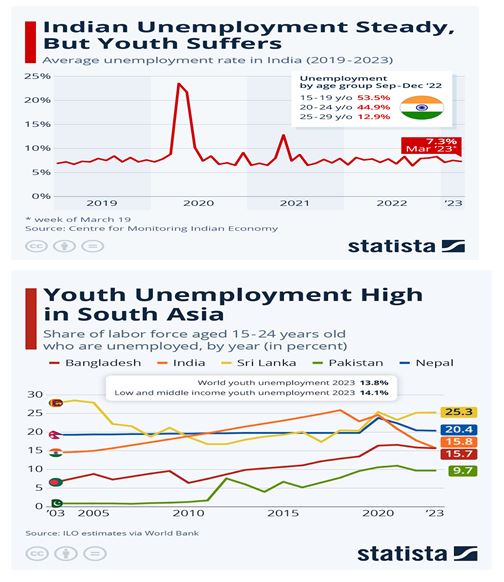
Unemployment and under employment : Besides securing stable jobs is also an issue as Indian economy is not able to generate sufficient number of jobs. Though it has been growing at about 7%, but it is more or less jobless growth. In fact the statistics from ILO shows that Indian unemployment of youth is as high as 15.8%. There is another statistics by CMIE which shows that unemployment rate is as high as 44% in age group 20-24. Beyond traditional employment metrics, many educated youths encounter underemployment or a lack of career stability relative to their skill sets. Broader systemic issues-including economic volatility, inflation, rising inequality, and emerging challenges like eco-anxiety-contribute significantly to long-term anxiety about the future.
Social & Familial Dynamics : In many Indian households, success is closely tied to collective family pride. Well-meaning parents often push young individuals toward narrow, traditional career choices (engineering, medicine, civil services), creating friction when personal interests diverge. Digital hyper-connectivity exposes youth to idealized lifestyles and curated success stories. Constant peer comparison fuels a sense of inadequacy and impatience.
How to Channel Youth Energy Constructively
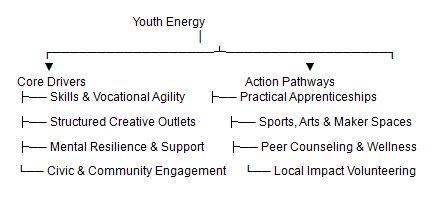
Transforming restless energy into purpose requires a balance of institutional reform and individual action.
Skill Development, Jobs & Modern Careers
Encouraging learning practical, market-relevant skills-such as software tools, digital design, trade skills, or entrepreneurship-to build self-reliance beyond traditional degrees is therefore desirable. Normalizing unconventional careers in technology, creative media, sports, and green energy are equally good career options thus easing the pressure associated with hyper-competitive entrance exams. Besides the government should reorient the economy in the direction that we may create more jobs. It is seen that there are a lot of vacancies in the government and PSUs which should be filled in transparent manner until private sector job in take improves. There should be regular recruitment in different government departments, vacancies of which should be regularly advertised year on year and schedule of recruitment by and large fixed.
Physical & Creative Outlets
Movement, sports, and outdoor activities serve as crucial outlets for releasing excess cortisol and building discipline. Establishing physical and digital spaces-such as maker labs, incubators, art collectives, or music workshops-where raw energy can be converted into tangible projects are options worth looking at.
Mental Well-being & Community Support
Promoting open conversations at home and in institutions is therefore necessary. Institutional access to counselors and peer support networks provides youth with safe spaces to process anxiety. Involving young people in local community initiatives, environmental conservation, or youth mentorship programs is equally desirable. Contributing to a cause provides a strong sense of agency and purpose and youth should be encouraged for that. Colleges and Universities can play a huge role in it.
(About Author : Mr. Pratap Singh is an IRS Officer with over 35 years experience of working at senior positions in Government across India. He is a trained Civil Engineer and holds M. Tech Degree in Civil Engg from IIT Kanpur. He worked as Asstt. Executive Engineer(Civil) in the Government and led important projects, before joining IRS.)
[The views expressed are strictly personal.]