PM lays bricks for 150-bed state-of-the-art Critical Care Block at PGIMER
Published: Jul 18, 2026
By TIOLCorplaws News Service
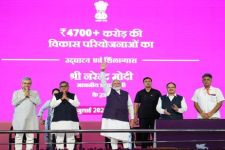
NEW DELHI, JULY 18, 2026: PRIME Minister Narendra Modi inaugurated the Advanced Mother and Child Centre and the Advanced Neurosciences Centre at the Post Graduate Institute of Medical Education & Research (PGIMER), Chandigarh, here yesterday. He also laid the foundation stone of a 150-bed state-of-the-art Critical Care Block under the Pradhan Mantri Ayushman Bharat Health Infrastructure Mission (PM-ABHIM) at PGIMER, Chandigarh. He was joined by Gulab Chand Kataria, Governor of Punjab and Administrator of the Union Territory of Chandigarh; Jagat Prakash Nadda, Union Minister of Health and Family Welfare; Ashwini Vaishnav, Union Minister of Railways and Manish Tiwari, Member of Parliament (Lok Sabha) representing Chandigarh.
Addressing the gathering, the Prime Minister said that the inauguration and foundation stone laying of advanced healthcare facilities at PGIMER would significantly strengthen access to quality healthcare for lakhs of people. Recalling his visit to PGIMER's convocation in 2015, he appreciated the remarkable expansion of its capacities over the past decade. He also congratulated the management, faculty and young doctors of PGIMER for their dedicated service.
Emphasizing the close link between sanitation and public health, the Prime Minister stated that "the Government had launched the Swachh Bharat Mission with the vision of making cleanliness a people's movement." He noted that the construction of crores of toilets, the elimination of open defecation, nationwide cleanliness campaigns, and initiatives to make sanitation a way of life have contributed significantly to improving public health. He also observed that the Swachh Survekshan rankings have encouraged cities such as Chandigarh to continuously improve their sanitation standards.
The Prime Minister lauded retired IPS officer Inderjit Singh Sidhu for inspiring citizens towards cleanliness through his "Broom Warrior" initiative. He noted that the Government had honoured Sidhu with the Padma Award this year in recognition of his contribution to promoting cleanliness.
Highlighting the importance of sustained public participation, the Prime Minister remarked, "Swachhata is not a one-day activity; it is a way of life." He appreciated the special cleanliness drive organised under the "Swachhata Se Swagat" initiative and congratulated the people of Chandigarh for their enthusiastic participation, noting that such campaigns play an important role in preventing diseases.
The Prime Minister stated that India's healthcare journey has undergone a transformational change over the past twelve years. Recalling the global concerns during the COVID-19 pandemic, he said that India emerged not as a country seeking assistance but as one extending support to nations across the world. He noted that India has today emerged as a major destination for medical tourism.
The Prime Minister said, "Twelve years ago, we resolved that no citizen should suffer due to the lack of healthcare facilities and that quality treatment should be available at affordable costs. The achievements of the last twelve years are the result of this resolve."
Highlighting the unprecedented expansion of healthcare infrastructure, the Prime Minister noted that "since 2014, fifteen new AIIMS have been approved, hundreds of new medical colleges have been established across the country, and specialized hospitals for the treatment of serious diseases such as cancer have been strengthened." Referring to the Homi Bhabha Cancer Hospital in Chandigarh, inaugurated in 2022, he said that the institute is now serving thousands of patients.
The Prime Minister underlined that the Government has accorded equal priority to strengthening primary healthcare. He said that under the Ayushman Bharat Health Infrastructure Mission, critical care blocks, integrated public health laboratories and public health units have been established across the country. He added that over 1.75 lakh Ayushman Arogya Mandirs are now operational across rural, urban and tribal areas, providing comprehensive primary healthcare services, including twelve healthcare service packages. He noted that crores of citizens have been screened for hypertension, diabetes and other non-communicable diseases through these centres.
Highlighting the role of technology in healthcare delivery, the Prime Minister said that the eSanjeevani telemedicine platform has transformed access to specialist consultations, with more than 48 crore telemedicine consultations conducted so far, enabling people in remote areas to access quality medical advice.
The Prime Minister stated that the expansion of healthcare services has contributed significantly to improving maternal and child health outcomes, with over 90 per cent institutional deliveries now taking place in the country. He noted that maternal mortality has declined by 86 per cent, while infant mortality has also witnessed a substantial reduction.
Emphasizing the Government's focus on preventive healthcare, the Prime Minister said that initiatives such as Poshan Abhiyaan, Mission Indradhanush, Yoga, HPV vaccination and the U-WIN platform are safeguarding the health of crores of citizens through timely preventive interventions.
Reaffirming the Government's commitment to eliminating tuberculosis, the Prime Minister said that the TB Mukt Bharat Abhiyan is being implemented with active public participation to ensure awareness, early screening and timely treatment. He noted that TB treatment coverage in the country has now crossed 90 per cent and, according to the World Health Organization, TB incidence in India has declined by 21 per cent over the past decade. He observed that these efforts have particularly benefited the poor, the middle class and women, many of whom often neglect their own health while prioritizing their families.
The Prime Minister remarked, "Healthcare is no longer a privilege in India; it is becoming the right of every ordinary citizen."
Highlighting the expansion of medical education, the Prime Minister observed that becoming a doctor was once a distant dream for many talented young people due to the limited number of medical colleges and seats. He noted that the number of medical colleges has nearly doubled and MBBS and postgraduate medical seats have witnessed record growth. He further announced that approval has now been granted for an MBBS college at PGIMER Chandigarh, with admissions expected to commence soon. He said this would provide talented youth with an opportunity to study at one of the country's premier medical institutions while strengthening India's healthcare workforce.
Highlighting the transformative reforms in the health sector under the leadership of Prime Minister Narendra Modi, Nadda stated that "the National Health Policy, 2017 laid the foundation for a comprehensive, holistic and inclusive healthcare system with a strong emphasis on preventive, promotive, curative, rehabilitative and palliative care."
He noted that Ayushman Arogya Mandirs have emerged as the first point of contact for healthcare for the country's 140 crore citizens, strengthening the delivery of quality primary healthcare services at the grassroots.
The Union Health Minister underlined that the government has adopted an integrated approach by effectively linking primary healthcare with secondary and tertiary healthcare, ensuring continuity of care for every citizen. He informed that 23 AIIMS have been approved across the country and are at various stages of development, significantly expanding access to quality tertiary healthcare and medical education.
Highlighting the expansion of medical education, Nadda stated that the number of medical colleges in the country has increased from 387 in 2014 to 818 today, while undergraduate medical seats have risen to over 1.38 lakh. He further informed that the government has undertaken the creation of 75,000 additional undergraduate and postgraduate medical seats, of which 25,000 seats have already been added.
Nadda said that the Ayushman Bharat Digital Mission (ABDM) is rapidly emerging as the world's largest digital health platform, transforming the delivery of healthcare through digital innovation. He added that nearly 90 crore ABHA (Ayushman Bharat Health Account) cards have been created, enabling citizens to securely maintain and access their digital health records.
Highlighting the significance of the new healthcare facilities being dedicated to the nation, Nadda said that the 300-bed state-of-the-art Advanced Neurosciences Centre marks a major leap in India's neurological healthcare infrastructure. He noted that for nearly five decades since 1967, PGIMER had only 25 beds for neurology and neurosurgery, making the new facility a transformative addition to the institute's healthcare capacity. Built at a cost of ?440 crore, the Centre brings comprehensive neurology, neurosurgery and neurocritical care services under one roof, significantly enhancing access to advanced neurological care. He further stated that the Advanced Mother and Child Centre is among the country's most advanced facilities for women and children, providing comprehensive and specialised clinical care under one roof.