Paatil calls for 'Jan Bhagidari' to strengthen Water Conservation Efforts
Published: Mar 24, 2026
By TIOLCorplaws News Service
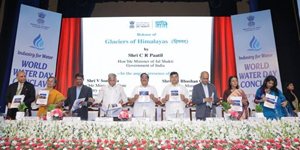
NEW DELHI, MAR 24, 2026: THE Ministry of Jal Shakti organized the World Water Day Conclave 2026 on 23 March 2026 at the Dr. Ambedkar International Centre, New Delhi, under the theme "Industry for Water", reaffirming the Government of India's commitment to sustainable water management, enhanced water-use efficiency, and a whole-of-society approach to water conservation.
The Conclave was attended by Union Minister of Jal Shakti C. R. Paatil; Ministers of State for Jal Shakti Raj Bhushan Choudhary and V. Somanna; Secretary, Department of Water Resources, River Development and Ganga Rejuvenation, V. L. Kantha Rao; Secretary, Department of Drinking Water and Sanitation, Ashok K. K. Meena; Chair, FICCI Water Mission & Past President, Shrimati Naina Lal Kidwai; Secretary, CSIR, Shrimati N. Kalaiselvi; President, Cosmos Group & Former President of ASSOCHAM, Anil K. Aggarwal; and Additional Secretary & Mission Director, National Water Mission, Shrimati Archana Varma, among other senior officials, industry leaders, and stakeholders.
Held in alignment with the global observance of World Water Day, the Conclave witnessed participation of over 700 delegates, reflecting a strong national resolve towards water security. The event served as a dynamic platform for multi-stakeholder convergence , bringing together government, industry, academia, start-ups, and State representatives to advance collective action for water sustainability.
The Conclave was inaugurated by the Minister of Jal Shakti, C.R. Paatil, who delivered a strong and forward-looking address, placing water conservation at the centre of national priorities.
In his address, the Union Minister emphasized that water conservation is not merely a policy priority but a shared national responsibility , requiring coordinated efforts across all sectors. He underscored the critical role of industry in driving water-use efficiency, promoting recycling and reuse, and transitioning towards a circular water economy .
Calling for a unified approach, he highlighted the importance of multi-stakeholder partnerships involving government, industry, agriculture, and communities. Stressing the role of public participation, he noted that "Jan Bhagidari se Jal Sanchay Sambhav hai" and expressed confidence that collective action can help India overcome emerging water challenges and move decisively towards a water-resilient Bharat.
Reinforcing the Prime Minister's call to "conserve every drop", the Minister reiterated that sustainable water management is integral to India's long-term economic growth, environmental sustainability, and climate resilience.
On the occasion, several key national reports and policy documents were released, including:
7th Minor Irrigation Census
2nd Census of Water Bodies
1st Census of Springs
1st Census of Major & Medium Irrigation Projects
National Water Data Policy 2026
Technical publications by NMCG, CGWB, and NRCD
These releases mark a significant step towards strengthening data-driven governance and evidence-based policy planning in the water sector.
A key highlight of the Conclave was the felicitation of 19 winners of the Jal Shakti Hackathon, recognizing innovative and scalable solutions developed by young innovators, start-ups, and institutions.
The Ministry also recognized leading industry associations and states for their completion of census exercise. States such as Bihar, Andhra Pradesh, and Assam were acknowledged for their timely and successful completion of major national water census exercises.
A Compendium of Good Practices on Industrial Water Use Efficiency was also launched, showcasing best practices in recycling, reuse, and sustainable water management across sectors.
The Conclave featured an exhibition with 21 stalls, where key organizations including NMCG, CGWB, Minor Irrigation divisions, and the National Institute of Hydrology, Roorkee, showcased innovations, technological interventions, and data-driven solutions in the water sector.
Leading industry associations such as ASSOCHAM, FICCI, and CII, along with MSMEs, actively participated and reaffirming industry's commitment to sustainable water practices. Industry stakeholders highlighted key focus areas including:
Scaling up water recycling and reuse
Leveraging emerging technologies such as AI and IoT
Driving collaborative action through partnerships and voluntary commitments
Key Deliberations across Thematic Sessions
The Conclave featured four thematic sessions covering critical areas:
Session 1: Stakeholder Workshop on Sludge Management (NMCG)
Another important parallel session was the Consultation Workshop on Effective Municipal Sludge Management in Indian Cities, organized under the theme "Sludge as a Resource: Closing the Loop in Urban Sanitation." The session focused on the urgent need to improve sludge management practices in Indian cities by addressing the full chain of handling, storage, transportation, treatment, and disposal. Discussions highlighted the current status of sludge management in the country, including gaps in institutional arrangements, inter-departmental coordination, and regulatory compliance, while also emphasizing the need for more efficient and sustainable urban sanitation systems.
The workshop placed strong emphasis on viewing sludge not merely as a waste stream, but as a recoverable resource with significant potential for reuse and value creation. Presentations and case studies explored a range of emerging technologies and management approaches, including biosolids management, biochar production, conversion of sludge into briquettes, RDF and alternative fuels, sludge incineration, and co-processing options. The deliberations underscored the importance of resource recovery, soil improvement, carbon sequestration, and energy generation as pathways for transforming sludge into an economically and environmentally beneficial component of urban sanitation planning.
The discussions also focused on city action plans and business models for long-term sludge management, including the choice between centralized and decentralized treatment systems and the design of self-sustaining sludge treatment centres. These models considered revenue streams from compost, soil conditioners, fuel recovery, and by-product utilization, while stressing the integration of sludge management into broader city sanitation frameworks. Overall, the session reinforced the need for policy support, technological innovation, institutional coordination, and financially viable models to enable Indian cities to move toward circular and sustainable sludge management systems.
Session 2: Industry for Water - showcasing sectoral best practices in efficiency and reuse
A thematic session on "Industry for Water" focused on enhancing water use efficiency across industrial sectors, bringing together industry representatives and associations. Attended by senior officials from DoWR, RD&GR and the National Water Mission, the session featured discussions on digital and AI-based solutions, circular water use, water neutrality, and recycling and reuse.
Deliberations highlighted key measures such as water audits, water credit systems, ESG integration, and reduction of non-revenue water.
The session concluded with the signing of a Joint Industry Declaration , reaffirming industry's commitment to improving water use efficiency.
The key commitments included:
Regular Water Audits by 2027,
SCADA-enabled real-time monitoring systems across facilities by 2030,
Achieving ZLD, water neutral/positive status by 2030,
Reducing water footprint by 50% by 2030,
Rainwater harvesting structures with upgraded treatment systems in all major facilities by 2030.
Session 3: Technical Workshop on Glacier (NMCG)
During the occasion, a series of thematic sessions and parallel technical discussions were conducted to deliberate on key water-sector priorities. One of the important parallel sessions was Technical Workshop on Glacier (NMCG), which focused on the growing significance of glaciers and the cryosphere in sustaining Himalayan river systems, influencing hydrology, and shaping water security in the Indian Himalayan Region. The session brought together experts, researchers, and practitioners to discuss emerging scientific evidence on glacier change, hydrological responses, spring systems, sediment dynamics, and the wider ecological and socio-economic implications of cryosphere degradation.
The deliberations highlighted the urgent need to better understand the linkages between glaciers, hydrology, river flows, springs, and baseflows, especially in the context of climate change and increasing stress on mountain water resources. Speakers emphasized the importance of strengthening cryosphere monitoring systems, including glacier observations, hydro-meteorological networks, and spring census efforts, so that scientific assessments can more effectively guide policy and planning. The session also drew attention to the role of sediment transport, hydro-geomorphic changes, and catchment processes in shaping river basin behaviour, with implications for infrastructure, watershed management, and long-term resilience planning.
A major focus of the session was on Glacial Monitoring Framework and an integrated approach to Glacial mass balance so as to have holistic picture of Himalayan Glaciers. Also, workshop focused on Glacial Lake Outburst Flood (GLOF) risk reduction, with presentations highlighting national efforts in glacial lake inventory, monitoring, mapping, and modelling. In particular, the presentation by Mr. Subhash Joshi, Scientist 'F', NRSC-ISRO, underscored the preparation of a comprehensive glacial lake inventory for the Indian Himalaya, publication of four Glacial Lakes Atlases, and the use of decision-support platforms such as Bhuvan. Overall, the session reinforced the need for stronger science-policy integration, improved data systems, and coordinated national action to address glacier loss, glacial hazards, ecosystem impacts, and the broader water-security challenges facing the Himalayan region.
Session 4: Use Cases of Water Census Data - demonstrating the role of data in governance and planning
In the session, presentations were delivered by Priyanka Kulshreshtha, DDG, MI Stat, on the use cases of Water Resources Census data, highlighting its implications for the Sustainable Development Goals.
Presentations were also made by the State Governments of Bihar, Andhra Pradesh, and Assam, showcasing the utilisation of census data in initiatives such as the Jal Jeevan Hariyali Mission and its linkage with the implementation of the Pradhan Mantri Matsya Sampada Yojana, PMKUSUM, irrigation planning, and planning for the upcoming utilisation of spring's data.
ATE Chandra Foundation shared insights on how water bodies' data is driving meaningful rejuvenation of water bodies on the ground.
ICAR discussed the critical role of Minor Irrigation schemes and Major & Medium Irrigation Project Census data in advancing sustainable irrigation practices in the country.
Key Outcomes
The Conclave underscored the importance of a whole-of-government and whole-of-society approach, with key outcomes including:
Strengthening data-driven decision-making
Enhancing industry participation in water conservation
Promoting adoption of advanced technologies
Encouraging cross-sectoral partnerships
The World Water Day Conclave 2026 reinforced India's national commitment towards water conservation and sustainable management, aligned with the vision of "Ideas, Innovation, and Action." The partnerships and deliberations emerging from the Conclave are expected to accelerate progress towards a water-secure, climate-resilient, and sustainable future.