NSFDC showcases success in bolstering entrepreneurship amongst depressed classes (See 'Corp Brief') Govt reviews BSNL performance for Q1 FY 2026-27 (See 'Corp Brief') India enters next phase of governance transformation with AI-driven administrative reforms: MoS (See 'Corp Brief') IPR - If infringing use is coupled alleged fraudulent online payment & earning schemes, conduct may be treated not merely as trademark infringement and passing off, but also as phishing & cyber fraud justifying urgent intervention: HC (See 'Legal Desk') MeitY releases 2nd edition of the Digital Threat Report 2025-26 for BFSI Sector (See 'Corp Brief') On Eve of Bharat Tex 2026, India prepares to host World's Largest Global Textiles Expo (See 'Corp Brief') IPR - In vitro screening method functions as diagnostic process, which is barred from patentability u/s 3(i) of Patents Act: HC (See 'Legal Desk') 'SANKALP' to guide CPWD's Journey towards Future-Ready Organisation: Union Minister (See 'Corp Brief') Healthcare facilities worth Rs 668 Crore to benefit 53 Lakh ESI Beneficiaries (See 'Corp Brief') Chouhan gives message of Green India during dialogue with Vriksh Mitra (See 'Corp Brief') IPR - If on visual comparison, rival medicinal marks are strikingly similar in essential features, overall get up and packaging, and where trade channels and consumer base are common, likelihood of deception is sufficient to justify interim injunction: HC (See 'Legal Desk') Lakhanpur among first towns selected under PM SVANidhi 'Street Food Hub' Plan: MoS (See 'Corp Brief') Paswan hails PMFME Scheme's landmark achievement of 2 lakh Credit-Linked Beneficiaries (See 'Corp Brief') 500 officials participate in inaugural webinar on Anemia and Adolescent Health (See 'Corp Brief') IPR - Purpose of summary judgment in commercial suits is to ensure time-bound disposal and that trial is not default norm: HC (See 'Legal Desk') Ministry of Textiles to organise 'Weave The Future 4.0 - Upcycling Edition' at Dilli Haat (See 'Corp Brief') IPR - For purposes of Sec 57 of Trade Marks Act, foreign proprietor may succeed in rectification by proving that its mark had acquired actionable recognition, even without formal commercial launch or direct sales: HC (See 'Legal Desk') Nadda chairs Steering Group Meeting of Ayushman Bharat Digital Mission (See 'Corp Brief') DoP and TRAI to conduct Village-Level Telecom Network Performance Survey (See 'Corp Brief') IBC - Demand notice in Form B under Rule 7(1) of Personal Guarantor Rules is only procedural requirement prior to filing and does not amount to invocation of guarantee: NCLT (See 'Legal Desk') Tech Innovation and disruption in Construction Industry (See 'CORP EINSICHT')

Secretary reviews PSSCIVE's Bagless Days Guidelines

Published: Jul 09, 2024
By TIOLCorplaws News Service

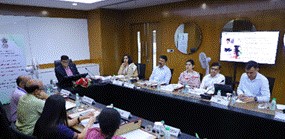
NEW DELHI, JULY 09, 2024: ON June 28, 2024, the Secretary (SE&L), Sanjay Kumar reviewed the guidelines developed by PSSCIVE, a unit of NCERT under MoE, for Bagless Days in schools. Participants from NCERT, CBSE, NVS, and KVS attended the meeting. Various suggestions were discussed, including sensitizing students about the local ecology, teaching them to test water purity, recognizing local flora and fauna, and visiting local monuments. Based on this review, PSSCIVE will further fine-tune and finalize its guidelines.

As per paragraph 4.26 of the National Education Policy (NEP) 2020, it is recommended that all students in grades 6-8 participate in a 10-day bagless period. During this time, students will intern with local skill experts and engage in activities outside of traditional school settings. This initiative aims to help students develop an appreciation for the larger ecosystem in which their school is embedded.

Based on these recommendations, PSSCIVE, has developed comprehensive guidelines for implementing Bagless Days. These guidelines are designed to make learning in schools more joyful, experiential, and stress-free for students.

Bagless Days will be encouraged throughout the year, encompassing a variety of activities such as arts, quizzes, sports, and skill-based learning. Students will gain periodic exposure to activities outside the classroom, including visits to historical, cultural, and tourist sites, interactions with local artists and craftsmen, and visits to various educational institutions within their village, tehsil, district, or state, as mapped by local skilling needs.


TIOL CORP SEARCH

TIOL GROUP WEBSITES